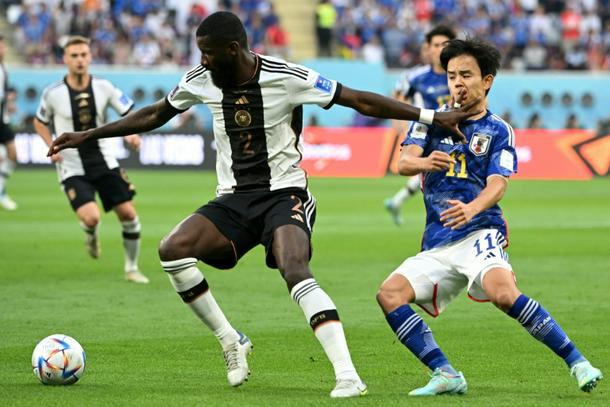
Germany's defeat to Japan at the 2022 World Cup in Qatar contributed to them being eliminated in the group stage, just as they were in 2018
Paris (France) (AFP) - The 2026 World Cup will be the first to feature 48 teams, with the expansion of the field offering opportunities to several debutants – but will FIFA’s determination to have more nations participating remove much of the jeopardy which helped make the competition so great?
The expansion is the delivery of a key proposal made by Gianni Infantino not long after he became president of world football’s governing body in 2016.
He talked of the importance of giving “more chances for more teams” and indicated that the World Cup needed to be seen as “more than a competition, it’s a social event.”
- ‘Natural evolution’ -
Certainly, for much of its history, the World Cup could not be described as genuinely global. It was dominated by Europe and a few South American nations as it settled on a 16-team format until being expanded to 24 in 1982.
Ten of the 16 participants in 1978 were European, while by 1990 in Italy there were 14 European sides out of 24.
Africa sent a total of four representatives to the first 11 World Cups before 1982. But even by 1990 there were just two teams each from Africa, Asia and the CONCACAF zone of North and Central America and the Caribbean.
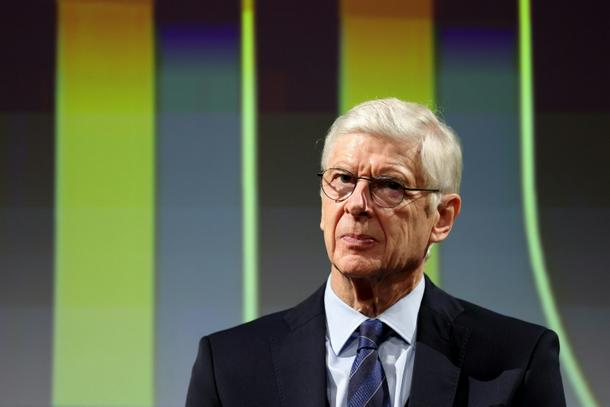
Arsene Wenger, the former Arsenal manager who is now FIFA's chief of global football development, called the expansion of the World Cup to 48 teams "a natural evolution"
The expansion to 32 teams from 1998 gave a fairer distribution of places worldwide, but still only five African nations went to Qatar in 2022, while 13 came from Europe.
The move to 48 ensures a more even share without removing qualifying spots from Europe -– it now has 16 teams, while there are 10 from Africa, nine from Asia, six each from South America and CONCACAF plus New Zealand.
“It’s a natural evolution. We want to make football global all over the world,” Arsene Wenger, FIFA’s chief of global football development, said in December.
“I believe that 48 teams is the right number. It’s less than 25 percent for 211 countries who are affiliated to FIFA.”
The expansion has allowed some of the world’s smallest countries to qualify for the finals for the first time – notably the tiny Caribbean island of Curacao with its population of barely 160,000.
“Once in a decade or once every four years, it happens that a small country is the surprise,” Curacao coach Fred Rutten told AFP, as he hopes to cause a major upset or two.
Cape Verde, Jordan and Uzbekistan are other first-time qualifiers. And the new format gives the outsiders a better chance of making it beyond the group stage and into the last 32, the first knockout round.
With the top two in all 12 groups progressing along with the eight best third-placed sides, one win in the first round could suffice to advance.
- ‘Dilution of spectacle’ -
But that means the competition will lose much of its early jeopardy, with the leading nations probably not too concerned even if they suffer a defeat straight off – unlike in 2022 when eventual champions Argentina were genuinely panicking after a defeat by Saudi Arabia.
Seeing a giant go out in the group stage, as Germany have done at the last two World Cups, is likely now a thing of the past.
In 2022 the group stage featured 48 games to eliminate 16 teams. This time there will be 72 matches in the first round to filter out the same number.
To go all the way, teams now have to play eight matches -– potentially in energy-sapping conditions in a North American summer – instead of seven previously, further adding to an already heavy load for leading players.

Curacao are one of the beneficiaries of the World Cup's expansion as they have qualified for the finals for the first time
“I see the argument about increasing representation but I think a 32-team finals was perfect,” says Jonathan Wilson, author of The Power and the Glory, A New History of the World Cup.
“The biggest problem with this is not really the quality, it’s the dilution of spectacle in the first round with eight third-placed teams to go through,” he tells AFP, suggesting the group stage may end up “trying peoples’ patience”.
In addition, he says the risk with another knockout round is that “it might encourage quite dull, cautious football”.
For the big teams, the first step is to just make sure you don’t unexpectedly slip up early on.
“You just focus on the group, this is what you do, and make sure you are in the right head space,” insisted England coach Thomas Tuchel.