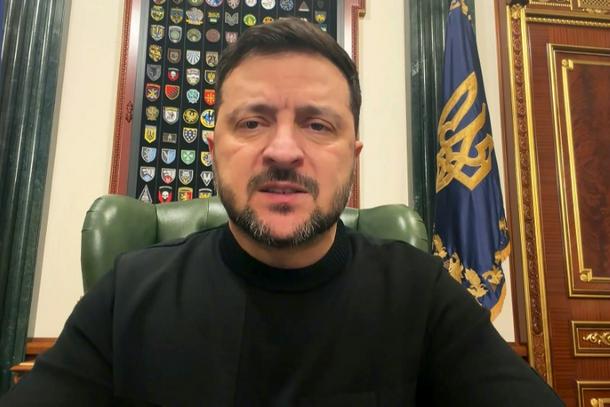
President Volodymyr Zelensky presented details of the latest version of a plan to end the Russian invasion
Kyiv (Ukraine) (AFP) - Ukraine won some concessions in the latest version of a US-led draft plan to end the Russian invasion, revealed by President Volodymyr Zelensky, though key questions remain over territory and whether Moscow could accept the new terms.
The 20-point plan, agreed on by US and Ukrainian negotiators, was being reviewed by Moscow, but the Kremlin is unlikely to abandon its hardline territorial demands for full Ukrainian withdrawal from the east.
Zelensky conceded there are some points in the document that he does not like, but Kyiv has succeeded in removing immediate requirements for Ukraine to withdraw from the Donetsk region or that land seized by Moscow’s army would be recognised as Russian.
Nevertheless, the Ukrainian leader still indicated the proposal would pave the way for Kyiv to pull some troops back, including from the 20 percent of the Donetsk region that it controls, where demilitarised zones would be established.
It also got rid of demands that Kyiv must legally renounce its bid for NATO membership.
Zelensky presented the plan during a two-hour briefing with journalists, reading from a highlighted and annotated version.
“In the Donetsk, Lugansk, Zaporizhzhia, and Kherson regions, the line of troop deployment as of the date of this agreement is de facto recognised as the line of contact,” Zelensky said of the latest version.
“A working group will convene to determine the redeployment of forces necessary to end the conflict, as well as to define the parameters of potential future special economic zones,” he added.
This appears to suggest the plan opens the way for, but delays, options that Ukraine was previously reluctant to consider – a withdrawal of troops and the creation of demilitarised zones.
“We are in a situation where the Russians want us to withdraw from the Donetsk region, while the Americans are trying to find a way,” Zelensky said.
“They are looking for a demilitarised zone or a free economic zone, meaning a format that could satisfy both sides,” he continued.
- NATO, land, nuclear plant -
US President Trump is trying to broker an to end the four-year war, triggered by Russia’s 2022 invasion.
Tens of thousands have been killed, eastern Ukraine decimated and millions forced to flee their homes.
Russian troops are advancing on the front and hammering cities and Ukraine’s energy grid with nightly missile and drone barrages. The defence ministry on Wednesday said it had captured another Ukrainian settlement in the southern Zaporizhzhia region.
Moscow in 2022 claimed to have annexed four Ukrainian regions – Donetsk, Kherson, Lugansk and Zaporizhzhia – in addition to the Crimean peninsula which it seized in 2014.
In Moscow, President Vladimir Putin has shown no willingness to compromise, doubling down on his hardline demands for a sweeping Ukrainian withdrawal and a string of political concessions that Kyiv and its European backers have previously cast as capitulation.
Any plan that involves Ukraine pulling back its troops would need to pass a referendum in Ukraine, Zelensky said.
“A free economic zone. If we are discussing this, then we need to go to a referendum,” Zelensky said, referring to plans to designate areas Ukraine pulls out from as a demilitarised free trade zone.
On NATO, Zelensky said: “It is the choice of NATO members whether to have Ukraine or not. Our choice has been made. We moved away from the proposed changes to the Constitution of Ukraine that would have prohibited Ukraine from joining NATO.”
Nevertheless, the prospects of Ukraine being admitted to the bloc appear slim-to-none, as it has been ruled out by Washington.
Moscow has repeatedly said NATO membership for Ukraine is unacceptable, presenting it as one of the reasons it invaded in the first place.
The plan sees joint US-Ukrainian-Russian management of the Zaporizhzhia nuclear power plant, occupied by Russian troops. Zelensky said he does not want any Russian oversight of the facility.
He also said Ukraine would hold presidential elections only after an agreement is signed – something both Putin and Trump have been pushing for.
Kremlin spokesman Dmitry Peskov told reporters Moscow was “formulating its position” and declined to comment on the specifics of the latest plan.
Russian officials have repeatedly criticised European and Ukrainian efforts to amend an original US plan that enshrined many of its demands.
Direct talks between Russian and Ukrainian negotiators earlier this year in Istanbul failed to break the deadlock and despite the flurry of diplomacy, the positions of the two countries appear to still be far apart.