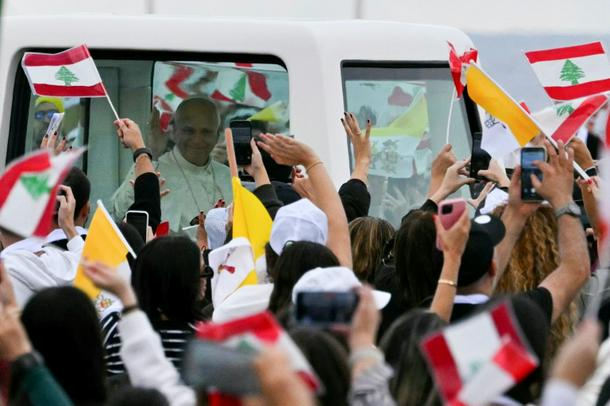
Crowds had gathered before dawn in expectation of the pope's arrival
Beirut (Lebanon) (AFP) - Tens of thousands of people gathered at Beirut’s waterfront as Pope Leo XIV held mass on Tuesday morning, the highlight of the Catholic leader’s visit to the capital.
Arriving for the service, the pope wound his way through the jubilant crowd in his popemobile as people offered roses.
The pontiff arrived from Turkey on Sunday on his inaugural visit abroad as pope and brought a message of hope, particularly to young people in Lebanon, whose faith in their beleaguered country has dwindled.
His trip has been a welcome distraction in a nation still reeling from a war last year between Israel and militant group Hezbollah, with many fearing renewed hostilities.
“We came with joy to participate in this heavenly celebration,” said Samira Khoury, among those who arrived early for the mass, which more than 120,000 people had registered to attend.
“The pope puts joy and peace in our hearts and strengthens our hope,” she told AFP.
Before the service, on the final day of his Lebanon trip, the pope prayed at the site of a catastrophic port explosion on August 4, 2020 which killed more than 220 people, injured over 6,500 and devastated swathes of the capital.
At a monument to those killed, with shipping containers, piles of rubble and the facility’s devastated wheat visible nearby, the pope lit a lamp after praying silently.
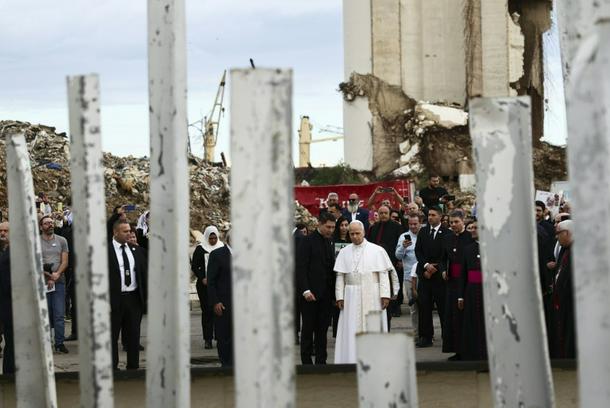
Pope Leo also visited the site of Beirut's massive 2020 port explosion where he met families of its victims
He then shook hands, blessed and spoke with survivors and relatives of victims, including children, many of whom were holding photos of their loved ones.
Cecile Roukoz, a lawyer whose brother died in the explosion, said “We are very grateful for this visit from the pope… We know that he raises his voice” for justice “and we need justice for our brothers and all the victims of this explosion”.
- ‘Can feel the peace’ -
Tens of thousands of people gathered before dawn for the mass on Beirut’s waterfront, some having travelled from abroad including from neighbouring Syria, or from further afield like the United States.
“It’s a sign of hope for Lebanon. I can feel the peace already just by seeing the people and how happy they are and I can see hope in their eyes for the future of Lebanon,” said Elias Fadel, 22.
“Hopefully there won’t be any war,” he added.
Migrant workers in Lebanon from countries such as the Philippines and Sri Lanka were also among the excited crowd.
Large swathes of the city centre were closed to traffic for the occasion and soldiers deployed on nearby roads.
Sandra Naim, 37, said “ I hope that peace will reign in this beautiful country that unites all sects and religions.”
“We thank the pope for his visit, which sows peace and hope,” she said.
Beatrice Doumet, 26, said she felt proud to be Lebanese.
“We need this because it’s a time of change, with a lot of uncertainty,” she said.
- ‘Marginalised’ -
Pope Leo’s first stop on Tuesday was at a psychiatric hospital run by nuns near the capital, where he was greeted by hospital staff and patients to cheers, applause and a shower of rose petals.
An emotional Marie Makhlouf, mother superior of the congregation of the Franciscan Sisters of the Cross, thanked the pope for being “a father to the forgotten, the abandoned and the marginalised”.
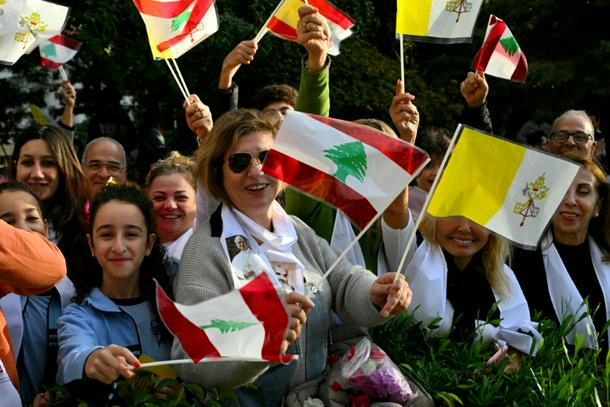
Pope Leo's visit comes with Lebanon still suffering from economic crisis and fearing a resumption of fighting between Israel and Hezbollah
Pope Leo paid tribute to the work of the hospital, saying that “what is lived in this place stands as a clear reminder to all.”
“We cannot forget those who are most fragile. We cannot conceive of a society that races ahead at full speed clinging to the false myths of wellbeing, while at the same time ignoring so many situations of poverty and vulnerability,” he said.
Nobody has been held to account for the Beirut port blast, one of the largest ever non-nuclear explosions.
Authorities have said the port blast was triggered by a fire in a warehouse where tonnes of ammonium nitrate had been stored haphazardly for years after arriving by ship, despite repeated warnings to senior officials.
The investigation is yet to yield results, with political figures obstructing the judge’s work on the case.
On Monday, the pontiff called on Christian and Muslim religious leaders gathered for an interreligious meeting to combat intolerance and violence.
He also got a rock-star welcome from some 15,000 youth in Bkerke, the seat of the Maronite church, urging them to “be the source of hope that the country is waiting for”.