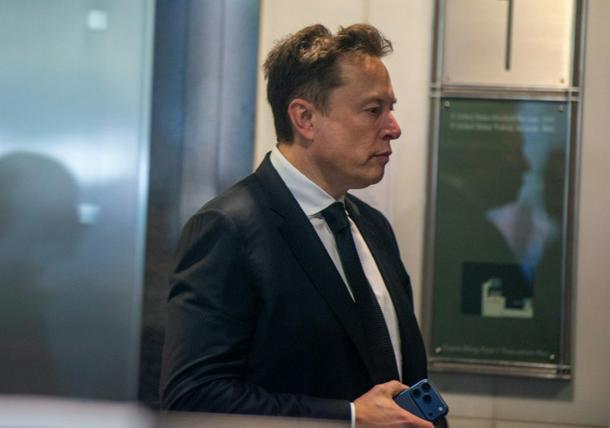
Elon Musk arrives at the federal courthouse as opening statements begin in his lawsuit against OpenAI
Oakland (United States) (AFP) - Elon Musk and OpenAI boss Sam Altman faced off in a California federal court Tuesday in a blockbuster trial that could have far-reaching consequences for the AI industry and oblige the ChatGPT maker to profoundly revamp its business.
The legal clash across the bay from San Francisco is widely seen as a battle of egos pitting the world’s richest person against a startup Musk once backed and now trails in the booming AI sector.
“We’re here today because the defendants in this case stole a charity,” said Musk’s attorney Steven Molo, the first to address the court ahead of lawyers from OpenAI and Microsoft.
“He is a legend, like him or dislike him,” Molo told the nine jurors, whose selection Monday revealed the deep reservations many Americans harbor toward the Tesla and SpaceX chief.
Even if the Tesla tycoon is widely admired as an entrepreneur, his sharp political turn and alliance with the Trump administration have alienated a significant share of the public.
Moments ahead of the opening statements, Musk and Altman, who both sat with their lawyers at the federal court in Oakland, were asked by Judge Yvonne Gonzalez Rogers to keep social media posts to a minimum during the course of the trial.
In a barrage of social media posts Monday amplified on the X platform he owns, Musk derisively called the OpenAI chief “Scam Altman.”
Altman was once a Musk friend and is now widely seen as his nemesis.
Behind the clash between Altman and Musk, this case revolves around who should control artificial intelligence, and for whose benefit.
- Nonprofit? -
The feud dates back to 2015, when Altman convinced Musk to co-found OpenAI, promising a nonprofit lab whose technology “would belong to the world.”
Musk invested at least $38 million, but the split was finalized in 2018, and the OpenAI Foundation created its commercial subsidiary a year later.
Microsoft then began investing and increased its commitment to $13 billion, a stake now valued at approximately $135 billion.
Ten years later, OpenAI has become a commercial juggernaut valued at $852 billion and is preparing for a high-profile IPO on the back of its ChatGPT chatbot, which took the world by storm in 2022.
But OpenAI’s convoluted governance structure – in which a nonprofit board retains ultimate control over a for-profit arm – has long unnerved investors wary of backing a company whose mission explicitly subordinates profit to the broader benefit of humanity.
Musk eventually set up his own lab, xAI, which he merged into SpaceX in February; SpaceX itself is valued at $1.25 trillion, and its IPO, expected in June, could become the biggest in history.
Musk argues in his lawsuit that he was deceived about OpenAI’s mission being altruistic.
OpenAI co-founders Altman and Greg Brockman “are confident in their position and look forward to the facts being known,” their attorney, William Savitt, said outside the courthouse after jurors were selected Monday.
- ‘Harassment campaign’ -
San Francisco-based OpenAI has countered in court filings that its break-up with Musk was due to the Tesla tycoon’s quest for absolute control rather than its nonprofit status.
“His lawsuit remains nothing more than a harassment campaign that’s driven by ego, jealousy and a desire to slow down a competitor,” OpenAI said of Musk in a recent X post.
Judge Gonzalez Rogers will decide by late May – guided by an advisory jury’s findings – whether OpenAI broke a promise to Musk in a drive to lead in AI, or just smartly rode the technology to glory.
Along with calling for OpenAI to be forced to revert to a pure nonprofit, Musk’s suit urges the ouster of co-founders Altman and Brockman, who is the startup’s president.
Musk, who had sought as much as $134 billion in damages, has since renounced any personal benefit, pledging to redirect any award to the OpenAI nonprofit.