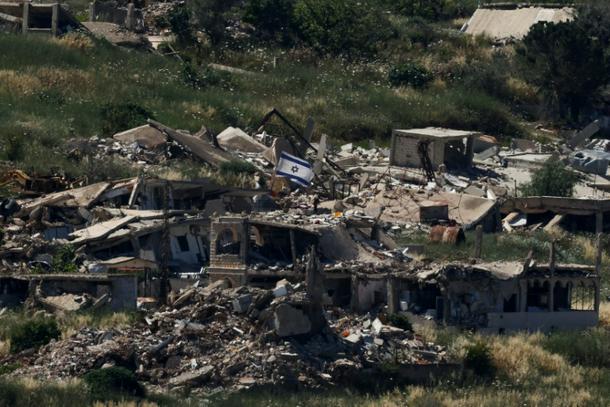
An Israeli flag is seen on top of a destroyed building in the southern Lebanese village of Kfar Kela near the two countries' shared border
Beirut (Lebanon) (AFP) - Lebanon’s leaders issued pointed calls for Iran to stop interfering in their country’s affairs on Friday, as Israel and Tehran-backed Hezbollah traded attacks after a new truce deal was flatly rejected by the group.
Lebanese state media reported fresh Israeli strikes on more than 40 locations Friday, while Hezbollah claimed new attacks on Israeli troops who have invaded the south.
Lebanon was drawn into the Middle East war when Hezbollah attacked Israel on March 2 to avenge the February 28 killing of Iran’s supreme leader.
Iran, in peace negotiations with Washington, has insisted that the fighting in Lebanon and the war in the Gulf are inextricably linked.
Lebanese Prime Minister Nawaf Salam addressed Iran’s leaders in frank terms during a press conference, saying: “Have mercy on our south, stop treating it and its people as merely a bargaining chip.”
“We are the people of a sovereign nation that refuses to serve as… an open battlefield for their wars.”
President Joseph Aoun offered a similar message for Iran in an interview with CNN. “It’s not your country, it’s our country,” he said. “It’s not your job to interfere into our country.”
Lebanese and Israeli envoys in Washington agreed to a truce this week that was conditional on a “complete cessation” of Hezbollah fire, without mentioning a halt to Israeli attacks.
Hezbollah rejected the deal on Thursday, demanding instead a comprehensive ceasefire and full Israeli withdrawal from south Lebanon.
Lebanese parliament speaker and Hezbollah ally Nabih Berri said Friday that the group would withdraw from the area south of Lebanon’s Litani River if these conditions were met.
Hezbollah had vehemently opposed the government’s engagement with Israel, with its leader Naim Qassem describing the talks as a “farce” – a stance Aoun disputed.
“Hezbollah must understand that (there is)… no other way to solve this problem and to save what’s left except through negotiation and diplomacy,” he said.
He also pressed Israel’s leaders, saying: “You need to show some willingness and commitment to end this war… We are committed. Are you?”
- ‘How long will this go on?’ -
Israel has staged its deepest incursion in two decades into Lebanon, and on Friday it warned residents of nine towns and villages to evacuate ahead of raids.
Lebanon’s official National News Agency reported mass displacement from some villages and subsequent strikes.
The Israeli military reported air raid sirens in the north triggered by “surface-to-air missile launches targeting Israeli Air Force aircraft”, but added that there was “no injuries or damage”.
An overnight Israeli strike near the Lebanese city of Tyre’s Jabal Amel hospital killed four people and damaged the facility, according to a civil defence source.
“I was in my mother’s hospital room when a powerful strike hit”, Marwan Ghorayeb told AFP.
“My house in my hometown was destroyed, and my house in Tyre was destroyed. How long will this go on?”
A strike on Thursday badly wounded a prominent environmental activist in her seventies, a medical source said. Mona Khalil had been holding out in her home in Mansouri near Tyre, near coastline that serves as a nesting site for endangered sea turtles.
Lebanon’s health ministry said a strike in Nabatieh district on Friday killed five people, including an emergency worker affiliated with Hezbollah ally the Amal movement. It condemned “the targeting of paramedics carrying out rescue operations”.
The ministry said Israeli attacks have killed at least 3,558 people since March 2.
In a joint statement, the foreign ministers of 11 countries – including Australia, Canada and France – and the EU expressed “profound concern over the continued escalation of hostilities”.
“The people of Lebanon have already endured immense hardship,” they added.
- ‘The job of the state’ -
In rejecting the new truce deal, Hezbollah chief Qassem demanded that any “ceasefire must be comprehensive… without the Israeli enemy having the freedom to kill”.
Israeli Defence Minister Israel Katz said after the deal’s announcement that the army would “at this stage, continue its fire and ground operations”, while retaining the “freedom” to strike Beirut if Hezbollah attacked Israeli communities.
Hezbollah is Lebanon’s only militant group that refused to hand over weapons after the 1975-1990 civil war, arguing that it was fighting Israel’s occupation of south Lebanon.
After Israeli troops withdrew in 2000, calls for Hezbollah to disarm multiplied, with the leadership under Aoun taking the firmest stance yet.
The Lebanese government has declared Hezbollah’s military activities illegal, and the army was working to disarm the group in areas near the border before the latest war erupted.
Aoun said Friday that dealing with Hezbollah was “the job of the state”, and not something Israel could accomplish itself.
Israel “can flatten the whole country, but they will never be able to achieve their objective”, he said, adding: “They’ve tried it in Gaza. Hamas still exists.”