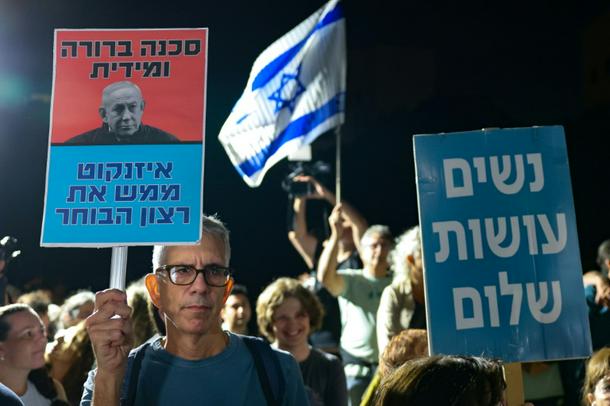
Israeli left-wing activists hold placards calling for the formation of a government in a demonstration outside the home of opposition leader Gadi Eisenkot in Herzilya on October 29, 2026
Herzliya (Israel) (AFP) - The Israeli opposition bloc led by Gadi Eisenkot gathered on Tuesday for the first time since elections as they strategise how to oust Prime Minister Benjamin Netanyahu, with divisions on whether to ally with Arab lawmakers.
Opposition party heads gathered in Herzliya, the tech industry hub north of Tel Aviv where former military chief Eisenkot lives, a week after the election produced an inconclusive result.
Yair Lapid, a centrist former prime minister who headed the opposition in the outgoing parliament, said as he entered that Netanyahu was backing an “extreme and dangerous attempt to invalidate the elections”.
“What we need to do now is go and form a government, because the conduct of recent days is just a reminder that we must remove Netanyahu and his people from the Prime Minister’s Office,” Lapid told reporters.
“They have already caused enough damage to the State of Israel and to the people of Israel,” he said.
Netanyahu and his allies have repeatedly alleged major fraud or malfeasance by Arab-majority parties which made historic gains last week, winning 19 seats in the 120-member parliament on the back of anger over the hard-right government’s rhetoric towards Arab citizens of Israel.
No side won a majority. Eisenkot’s diverse opposition bloc won 48 seats while Netanyahu’s camp secured 53, of which 27 are from his Likud party.
The Arab parties could bring Eisenkot to a majority but the opposition is divided on whether to ally with them, and Arab politicians did not join the talks in Herzliya.
Despite their diverging views on various issues, including the role of Arab lawmakers, all the party leaders in Eisenkot’s bloc have said they would back him to form the next government.
Public opinion polls conducted before the election showed that Jewish Israeli opposition supporters are divided over including Arab parties in government while right-wing Israelis are adamantly opposed.
- ‘Political reality’ -
Yousef Jabareen, the head of the largest Arab-majority party in the next parliament, told AFP that the opposition needed to accept “political reality” and team up to remove Netanyahu.
Arab-Israelis are descendants of Palestinians who remained after Israel’s creation in 1948 and account for around 20 percent of the population today.
On the campaign trail, most of the main Jewish opposition parties rejected partnering with the Arab-majority lists citing a lack of common values, particularly around security and national identity.
The notable exception was Yair Golan, head of the left-wing party The Democrats, who said it was racist to exclude working with the Arab minority.
Netanyahu spent the campaign painting Arab parties as untrustworthy and stoking fears of a Palestinian state.
Avigdor Liberman, a right-wing member of Eisenkot’s bloc who heads the Yisrael Beiteinu party, on Tuesday stressed that another election must be avoided but said that the Arab lists should not be included in the government.
“Given the political situation that has emerged, there is enough room to manoeuvre, and with proper navigation it is possible to quickly establish a functioning and stable government without Raam and the Joint List,” he wrote on X, referring to the two Arab-majority lists.
On Monday, Netanyahu called for a “broad national government” without the Arab parties and said that as his Likud was the largest single party, he should lead the next coalition.
No opposition leader has voiced any openness to a unity government with Netanyahu, Israel’s longest-serving prime minister, pointing to his divisiveness, the corruption charges against him and his failure to prevent the October 7, 2023 attack by Hamas.
“We seek to establish a broad government with our partners and with any party that wishes to join and does not support terrorism,” Netanyahu said in a Telegram post.
He ruled out a coalition with Arab-majority lists, alleging that the parties “support terrorism and deny the existence of the Jewish state”.
Leaders of Arab-Israeli parties have unanimously condemned the October 7 attack by Hamas without describing the Palestinian Islamist movement as a terror group.
Although the leader of the Raam party has recognised Israel as a “Jewish state”, other leaders have rejected that definition.