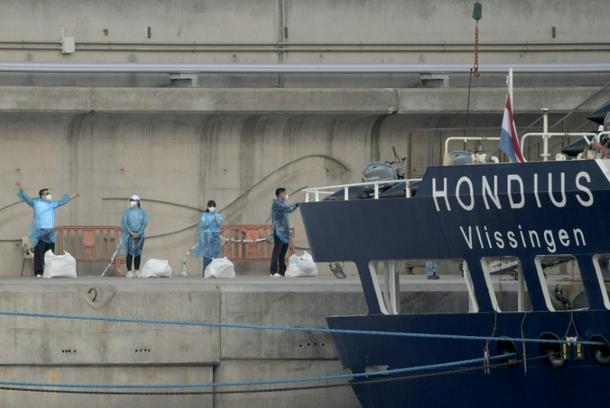
Passengers were taken off the MV Hondius in Tenerife
Granadilla de Abona (Spain) (AFP) - A cruise ship hit by a deadly hantavirus outbreak left Spain’s Canary Islands bound for the Netherlands on Monday, after the last passengers on board disembarked and were flown home to quarantine.
Three people died after the rare virus that usually spreads among rodents was detected on board the MV Hondius, sparking a global health scare.
No vaccines or specific treatments exist for the virus but health officials have insisted the risk to the public was low and dismissed comparisons to the Covid-19 pandemic.
“Mission accomplished,” exulted Spanish Health Minister Monica Garcia Gomez, on the quay of the port of Granadilla de Abona, in Tenerife.
“Between yesterday and today, we have evacuated the 125 passengers and crew members from 23 countries, who have either already returned home or are in the process of being repatriated. The ship, as you can see, has just weighed anchor. It left the port today at 7:00 pm (1800 GMT),” she said.
The 28 people evacuated on Monday boarded specially chartered buses to Tenerife South Airport.
Two planes then took them to the Netherlands, with the first arriving early Tuesday. One plane carried carried mostly crew members (17 Filipinos, a Dutch national, and a German), along with a few cruise passengers, while a second flight, departing a little later, took six other passengers - four Australians, a New Zealander, and a Briton living in Australia.
Cruise operator Oceanwide Expeditions said the MV Hondius was expected to arrive in Rotterdam on Sunday evening.
The ship has 25 crew and two medical staff on board, and is also carrying the body of a German passenger who died during the cruise, it added.
The complex evacuation procedure saw 94 people of 19 different nationalities taken from the Dutch-flagged vessel on Sunday.
Spanish authorities said the vessel, which was originally only authorised to anchor offshore on health and safety grounds, docked in port because of unfavourable weather.
At a press conference at the port, World Health Organization chief Tedros Adhanom Ghebreyesus, who is due to meet the Spanish prime minister in Madrid on Tuesday, sought to reassure the passengers.
He said they were in good hands now and that the situation could have become difficult if they stayed on the ship but added that this “is not another Covid”.
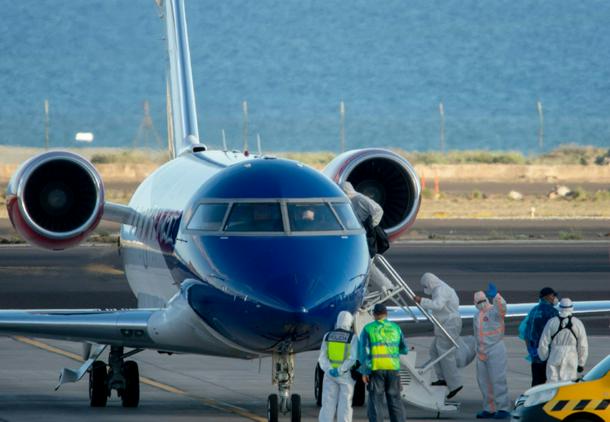
Passengers have been repatriated by plane and quarantined as a precaution
- Search for contacts -
Among the completed repatriations, a French woman, one of five evacuees from France placed in isolation in Paris, started to feel unwell on Sunday night, and “tests came back positive”, Health Minister Stephanie Rist said.
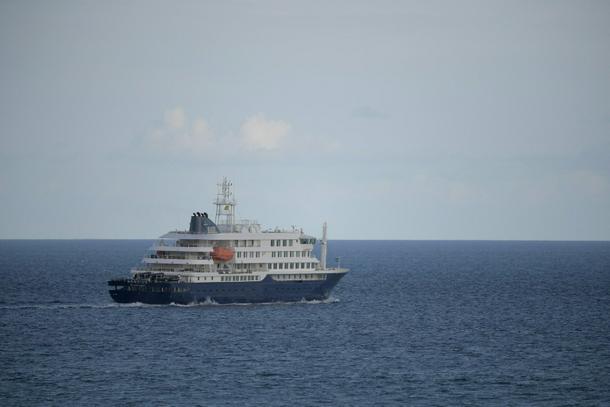
The ship is expected in Rotterdam on Sunday evening
A Spanish passenger has also tested positive, the health ministry in Madrid said, adding that results for the 13 other Spanish evacuees were so far negative.
Spain’s health ministry defended the rigour of the evacuations, where medical teams escorted passengers from the ship to an airport on Tenerife under close supervision and following health checks.
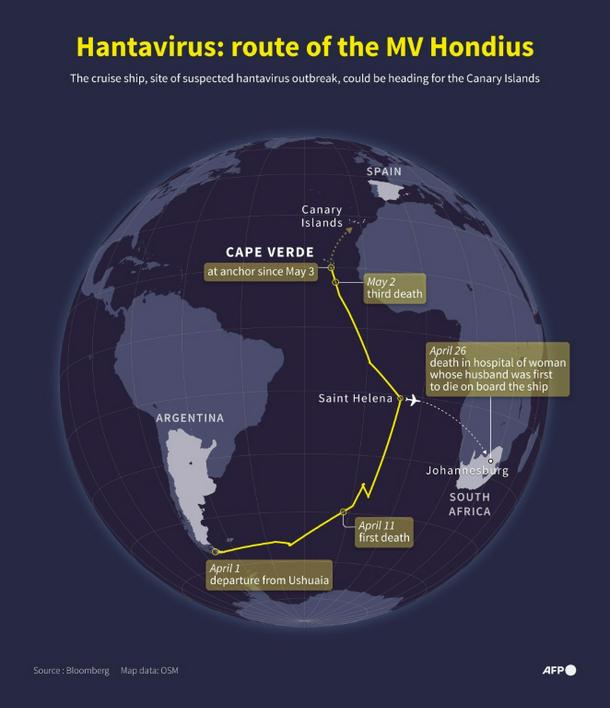
The ship left Ushuaia in Argentina for Cape Verde
“From the start, all the measures adopted have aimed at cutting the possible chains of transmission…all measures for prevention and control of transmission have been applied,” it said in a statement.
Seven cases have been confirmed in the outbreak, and one listed as “probable”, according to the World Health Organization and national health authorities, with citizens of six countries affected.
Other suspected cases and potential close contacts with infected people are being investigated, with health authorities in several countries tracking passengers who had already disembarked from the ship, plus anyone who may have come into contact with them.
In a video shared on Monday by Oceanwide Expeditions, captain Jan Dobrogowski paid tribute to the “unity and quiet strength” of everyone on board and highlighted the “courage and selfless resolve” of the crew.
The MV Hondius left Argentina, where hantavirus is endemic, on April 1 for a cruise across the Atlantic Ocean to Cape Verde.
The WHO believes the first infection occurred before the start of the voyage, followed by transmission between humans on board the vessel.
But Argentine health officials have questioned whether the outbreak originated in Ushuaia, based on the virus’s weeks-long incubation period and other factors.
burs-al/ach/jgc