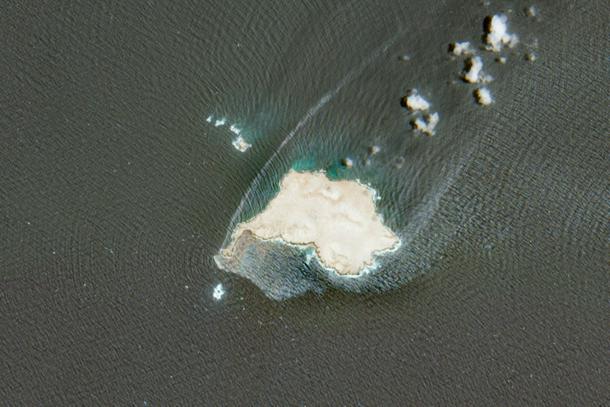
This satellite image obtained from Copernicus Sentinel Data 2026 shows a slick that is consistent with an oil leak emanating from a ship, stranded for over a month near Qibliyyah island off Oman's southern coast in the Arabian Sea
Dubai (AFP) - Oman is facing an impending environmental catastrophe as an alleged Russian shadow fleet tanker leaks oil across hundreds of square kilometres near a nature reserve, NGOs warn.
The ship was rocked by explosions, a maritime security firm told AFP, but the cause of the blasts is unclear.
Russia has built up a ghost fleet of old ships with opaque ownership to get around Western sanctions since its 2022 Ukraine invasion, and experts have said the vessels’ poor condition increases the risk of oil spills.
Satellite imagery verified by AFP showed what appeared to be an oil slick spreading from a ship that has been stranded for over a month near al-Qibliyyah island, off Oman’s southern coast.
It is far from the Strait of Hormuz, which has seen regular tanker attacks in the Middle East war.
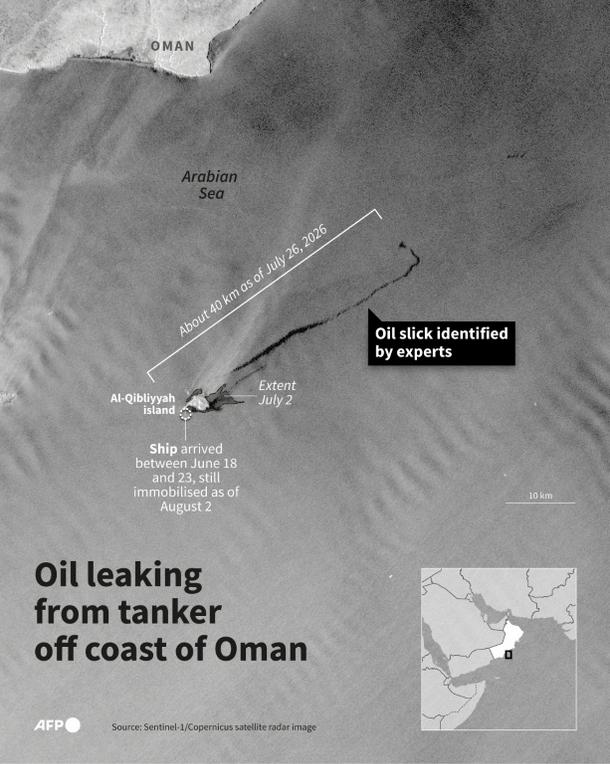
Infographic with a July 26, 2026 satellite radar image from Europe's Copernicus programme, showing a long dark area of ocean, identified by experts as an oil slick, leaking from a tanker stranded near the Omani island of Al-Qibliyyah
“With oil apparently continuing to leak and the vessel stranded in a difficult location, the risk of an even larger environmental disaster remains serious,” Nina Noelle of Greenpeace told AFP.
She warned of a “severe and long-lasting” consequence.
Greenpeace said the oil sheen had expanded from up to 20 square kilometres on July 24 to an estimated 600 on August 4, according to satellite imagery it reviewed.
Environmental open-source investigator Wim Zwijnenburg, from Dutch peace organisation PAX, gave the same estimate for the August 4 sheen.
Kpler data showed that the Caroline Bezengi, which is believed to be the ship leaking off Oman, loaded one million barrels of crude oil at the Russian Black Sea terminal of Sheskharis on May 11.
It still had the oil when its last signal was recorded a month later.
- Threat to fishing, biodiversity -
Large stretches of the island’s shoreline appear affected and “additional oil slicks extend far out to sea, further polluting and damaging this protected marine ecosystem”, Noelle said.
Zwijnenburg added that “a complete break of the ship can cause a regional environmental catastrophe, affecting both the lives of Omani fishing communities and the wider marine and island biodiversity”.
Last year, Oman established a marine reserve around the al-Hallaniyat islands, which include al-Qibliyyah and are home to diverse marine life including rare sea turtles.
“Timely intervention and salvaging the oil tanker is of essence to prevent worse,” Zwijnenburg said.
The International Maritime Organization told AFP it was “currently offering assistance to Oman”, without providing further details on the incident.
Oman did not respond to an AFP request for comment.
“Oil contamination in the Hallaniyat Islands threatens coral reefs, seagrass meadows and coastal habitats that support endangered sea turtles, migratory seabirds and marine mammals,” Noelle said.
Turtles nest and lay their eggs on the beach while many seabirds breed on the islands, with surrounding waters home to the rare Arabian Sea humpback whale, she added.
“Even relatively small oil spills can persist in marine sediments for years, compromising the ecological resilience of this protected marine ecosystem.”
- Shadow fleet -
In February, the United Kingdom imposed sanctions on the Caroline Bezengi for its suspected involvement in shipping oil from Russia.
Oil exports bring in crucial revenue for Russia’s stuttering economy.
Maritime security firm Vanguard Tech told AFP three explosions rocked the ship on June 6, flooding several areas including the steering gear compartment and pump room.
It is not clear what caused the explosions, or whether the ship was attacked.
Vanguard said the main engine and steering gear were “rendered inoperable”, adding that the crew was accounted for.
The vessel last emitted a radio transmission while it was off the coast of Yemen on June 11, according to ship tracking sites reviewed by AFP.
Satellite imagery from Europe’s Copernicus programme reviewed by AFP suggests that a ship became stranded off al-Qibliyyah island between June 18 and 23.
Its size, shape and deck colour are consistent with earlier satellite observations of the Caroline Bezengi before it turned off its AIS transponder signal.
According to Noelle, the Caroline Bezengi was an example of the “grave environmental risks” associated with Russia’s ghost fleet.
“Sanctions are being circumvented using ageing and poorly maintained tankers, putting coastlines and marine ecosystems at risk,” she said.