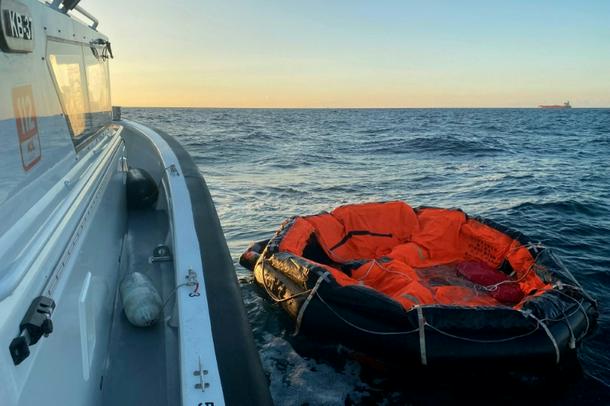
A lifeboat from the Tugberk Imamoglu cargo ship was recovered by rescuers but it was empty
Istanbul (AFP) - A Turkish cargo ship sank in the Marmara Sea near Istanbul after colliding with a second vessel, and rescuers were searching for its 10 crew members, officials said Wednesday.
The ALSU, an empty oil tanker, collided before dawn with the Tugberk Imamoglu, a cargo ship carrying rolled steel which sank shortly afterwards, the transport ministry’s maritime directorate said on X.
“Due to the Tugberk Imamoglu not responding to any calls and the crew not answering their mobiles… it is believed the cargo ship has sunk,” it said.
The collision struck 18 nautical miles off Silivri district on the western edge of Istanbul province. Transport Minister Abdulkadir Uraloglu told journalists the damaged vessel had sunk “very quickly”.
“We received the emergency call at 3:26 am. If we accept the captain’s reported (collision) time of 3:15, we can say the sinking occurred very rapidly, within just 11 minutes,” he said.
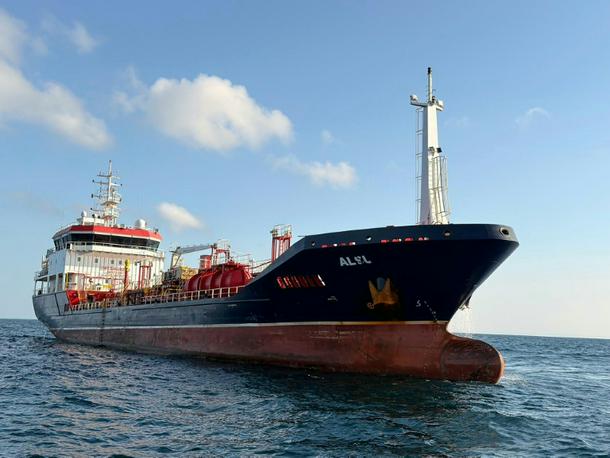
The ALSU oil tanker was empty when it collided with the Tugberk Imamoglu cargo ship
“We spotted life buoys and a lifeboat but it was empty. Unfortunately, no survivors have been found so far.”
He said there were 10 people on board: the captain and nine other crew members, all of them Turkish nationals.
The maritime directorate had earlier said the ALSU’s captain had put out an emergency call at 3:41 am, saying he had “collided with an unidentified vessel around 3:15 am”.
It said rescue vessels were immediately dispatched, reaching the site at 4:10 am.
The cargo ship went down in waters that were approximately 900 metres (more than half a mile) deep, the maritime directorate said. It said 14 vessels and a helicopter were involved in search and rescue efforts.
The ALSU, which was not damaged in the collision, was also helping with the search and rescue efforts, it said.
- ‘Tanker’s captain sailed away’ -
What caused the collision was not immediately clear but the Tugberk Imamoglu’s owner told Turkish media that the captain had repeatedly tried to warn the oncoming tanker.
“My captain was calling him, saying: ‘You’re coming too close’,” owner Tahsin Dogruyol said tearfully, adding that the tanker did not respond, so the captain tried again.
“The sad part is that no one was notified for over 30 minutes. Frankly, I can’t understand it,” he told A Haber television, giving a timeline of events that mirrored that initially given by the maritime directorate.
In a separate interview, Dogruyol accused the ALSU’s captain of failing to join the rescue effort after the collision.
“How can you just leave and go? Under maritime law, there is a duty to save lives and property. It’s not a choice,” he told private broadcaster CNN Turk.
“If the coastguard says a search-and-rescue operation is under way, you are obliged to alter your course and assist. Here, you have caused an accident and then sailed away,” he said.
Experts said the collision was likely down to human error.
“The Sea of Marmara is a heavily trafficked and closely monitored area, it has all the characteristics of a maritime highway,” maritime engineer Sabri Gokhan told the private NTV broadcaster.
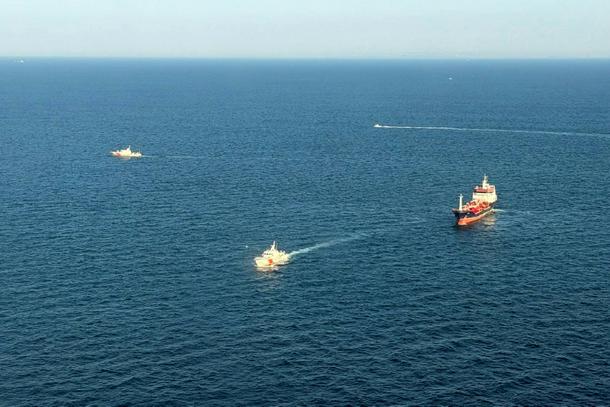
Search and rescue operations continued
“Ships don’t sink easily there. It was likely a mistake by the crew,” he said.
According to the VesselFinder tracking website, the Tugberk Imamoglu is a Turkish-flagged cargo ship built in 1990 and 90 metres (300 feet) long.
At the time of the collision, it was carrying 4,200 tons of rolled sheet metal and rebar steel reinforcements, the authorities said.
The maritime directorate initially said the ALSU was carrying 3,000 tonnes of motor oil, but later said the tanker was empty, a detail confirmed by the governorate.
Three days earlier a deadly ferry accident struck off Northern Cyprus in which eight Turkish nationals died, with rescuers still hunting for another 20 people listed as missing.
The last fatal shipwreck in the area occurred in September 2018 when a ferry sank, leaving one person dead and four missing.
The Sea of Marmara lies between the Black Sea and the Aegean Sea.