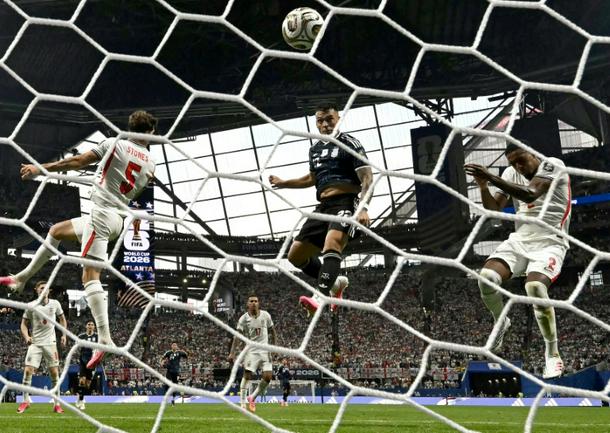
England's World Cup semi-final with Argentina was the most bet upon match
Paris (France) (AFP) - The World Cup has “exceeded expectations” with an 80% increase in betting volume compared to the 2022 edition, even taking into account the higher number of matches for a 48-team tournament, a betting expert told AFP.
Although many football fans were sceptical about the increase in the number of teams from 32 to 48, it appears punters have welcomed it.
“We’ve seen an 80% increase in the ticket volume,” Darren Small, senior vice president of Managed Trading Services at Sportradar, told AFP.
“So we’re seeing more bets and more active customers.
“We’ve seen record numbers and we’ve surpassed our expectations in terms of what we felt we were going to see if we compare it to 2022, which is a little difficult because it was different as it was in the winter.”
For Sunday’s final between Spain and defending champions Argentina, Small expects the company to be handling approximately 8.5 million betting tickets for their 250 bookmaking clients round the world.
Sportradar Group AG is a global sports technology company that says it creates immersive experiences for sports fans and bettors.
Small said even if the numbers have surprised the company, they anticipated an increase because of the expansion of the tournament to 104 games.
“But we also expected it just because of the industry growth and general growth,” Small added.
England may have to wait another four years to try to add a second star to their 1966 triumph but they have topped the betting table.
Indeed the four semi-finalists – also the top four FIFA-ranked teams – drew the most interest.
England attracted approximately 16.3 million betting tickets ahead of France (15.5m), Argentina (15m) and Spain (14.5m).
The games with the highest volume of betting tickets were England’s 2-1 semi-final defeat by Argentina, which generate approximately 5.8 million, England’s 2-1 quarter-final win over Norway (5.7m) and Spain’s 2-0 semi-final victory over 2018 champions France (5.3m).
- ‘Switch off’ -
David Stevens, head of public relations at historic English bookmaker Coral, said their concerns over the enlarged format had been put to rest by a group stage that threw up its fair share of surprises.
“Our fear was there would be a large proportion of predictable results, with the so-called smaller nations offering little or no resistance to their established rivals,” he told AFP.
“But in the event, that was not the case at all.
“Throughout the group stage there were plenty of matches where the result did not go according to the betting.”
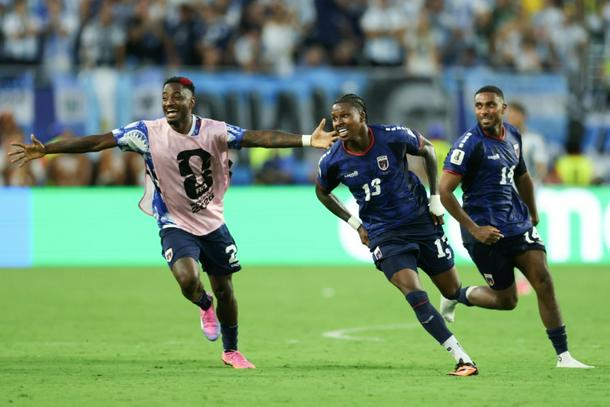
Cape Verde's performances allayed fears the smaller countries would be devoured by the heavyweights at the World Cup
Chief among those was Cape Verde, who more than held their own against Argentina in the last 32, bowing out in a 3-2 thriller after extra-time.
“Special mention must go to Cape Verde,” said Stevens.
“The Islanders are every bookmakers’ new favourite team having held both Argentina and Spain to draws, so I suppose… to a large extent, those fears we had at the start didn’t really come back to bite us.”
The increase in betting interest has been sparked also by offers not just on which team will win but on the individual players and a whole range of other potential outcomes.
“You could be backing Messi to score with his left foot in the first 25 minutes, Spain to go on to win 3-1 and there to be 15 corners, 2 assists,” said Small.
Perhaps spurred on by the success of the 48-team format, powerful FIFA president Gianni Infantino has dangled the possibility of enlarging it even further to 64.
“Would we welcome an even bigger World Cup in four years? ‘No’ is the simple answer,” said Stevens.
“There has to be a point at which fans and punters alike switch off as a result of too many games, and 64 teams feels very much like that point.
“However, Mr Infantino wants it to happen, and therefore, it’s probably a safe bet that it will happen, such is his current power over FIFA.”
pi/gj