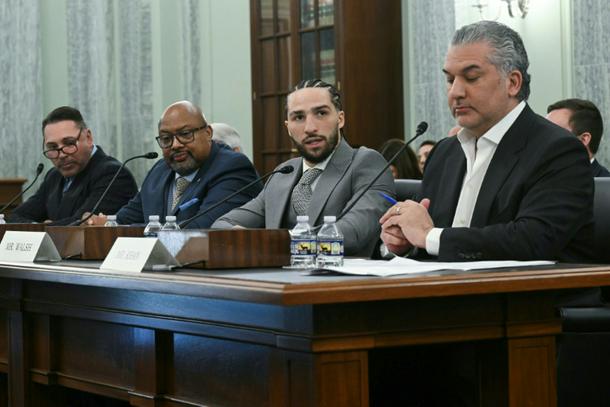
Oscar De La Hoya and Nico Ali Walsh were among the witnesses who testified during a Senate Committee on Commerce, Science, and Transportation hearing to examine federal boxing laws
Washington (United States) (AFP) - Oscar De La Hoya and Muhammad Ali’s grandson on Wednesday slammed proposed changes to federal boxing laws, warning a US Senate committee that the reforms would prioritize corporate profits and Saudi investors over fighters.
Approved last month by the House of Representatives, changes to the Muhammad Ali Boxing Reform Act would allow the creation of Unified Boxing Organizations, or UBOs, in which a single entity can serve as governing body and promoter.
Supporters say the reforms simplify and streamline a fragmented and confusing sport that has lost ground in recent years to mixed martial arts, which operates under booming centralized leagues like Ultimate Fighting Championship (UFC).
Witnesses at a Senate hearing accused boxing’s multiple sanctioning bodies of corruption or extortion, pointing to fighters who have had title belts stripped over financial disputes, and said a unified code would boost in-ring safety.
But the changes – which Committee on Commerce, Science, and Transportation chair Ted Cruz said he expects to introduce to the Senate “soon” – were fiercely opposed by other witnesses, including former boxing great De La Hoya.
“This is a fundamental shift in power that if changed would put corporate profits first, fighters second,” said De La Hoya, who now owns Golden Boy Promotions.
The Olympic boxing gold medalist turned professional world champion said the reforms “align directly” with Zuffa Boxing, a recently launched Saudi-owned boxing promoter that is a joint venture with UFC’s parent company TKO Group Holdings.
“Zuffa Boxing is fully funded by Saudi Arabia. We’ve already seen how that kind of funding reshaped another sport through LIV Golf,” said De La Hoya.
“We should be honest about what is happening here. That was sportswashing, a clear effort to use sports to reshape reputations.”
He said reports that LIV Golf may soon lose its Saudi funding and could be on the brink of collapse “should serve as a warning.” LIV Golf has denied those reports.
Nico Ali Walsh, grandson of Muhammad Ali and a professional boxer in his own right, also railed against the reforms.
He said the original Ali Act since 2000 has protected fighters from previously rampant anti-competitive and exploitative practices by promoters.
The proposed reforms would “undermine that principle” by replacing “an open market with a controlled structure.”
He said UFC fighters “typically receive under 20 percent of the revenue, compared to boxing, where fighters can earn up to 80 percent.”
“If this bill is passed in its current form, it should not have my grandfather’s name on it,” he said.